A trailer rarely gives you much warning before a small issue turns into a wasted day. One tired wheel bearing, one cracked cable or one set of uneven tyres can leave you stranded at the roadside or towing something that simply does not feel right. If you are looking at how to service a trailer, the job is really about preventing those problems before they become expensive, inconvenient or unsafe.
What servicing a trailer actually involves
A proper trailer service is more than a quick look at the tyres and a check that the lights still work. The aim is to inspect the parts that wear, adjust the parts that move, and replace anything that is beginning to fail. That usually means looking closely at the running gear, brakes, couplings, electrics, tyres and chassis.
The exact work depends on the trailer type, its age and how hard it is used. A small domestic trailer that only sees occasional tip runs will need different attention from a braked caravan trailer, plant trailer or goods trailer used every week by a tradesperson. Even so, the basic principle stays the same. You are checking that it tows safely, stops properly and remains roadworthy.
How to service a trailer step by step
Before starting, park the trailer on level ground, chock the wheels and make sure it is stable. If any part of the trailer needs to be raised, use suitable lifting equipment and axle stands. Never rely on a jack alone.
Start with the chassis and frame
Begin with the structure itself. Look for corrosion, cracked welds, bent sections and any signs of impact damage. Surface rust can often be treated before it becomes serious, but heavy corrosion around mounting points, suspension fixings or the drawbar needs proper attention.
Check that the bed, sides, tailgate, hinges and latches are secure and working as they should. If the trailer is used for work, these areas often take more abuse than owners realise. A tailgate that does not close squarely or a floor that has softened around fixing points is not just untidy – it can affect how the load sits and how the trailer behaves on the road.
Inspect the coupling head and jockey wheel
The hitch assembly needs to lock securely onto the towball with no excessive play. Inspect the coupling head for wear, damage and smooth operation. If the trailer has a braked coupling with a damper, look for stiffness, knocking or poor movement, as these can point to wear inside the overrun unit.
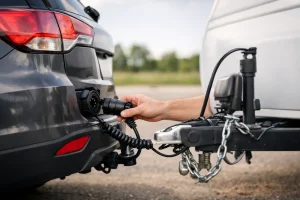
The breakaway cable or secondary coupling must be in good condition and correctly attached when towing. Frayed cables, bent clips or improvised fittings should be replaced. Then check the jockey wheel. It should wind smoothly, clamp firmly and support the trailer properly without slipping.
Check the trailer electrics and lighting
Trailer lighting faults are one of the most common problems we see. Test the plug, cable and all lamps, including indicators, side lights, brake lights, fog light and number plate lamp where fitted. Poor earthing, damaged plugs and water ingress inside lamp units are all common causes of failure.
While checking the electrics, inspect the cable routing. Wires should be clipped up and protected from rubbing, stretching and road spray as much as possible. If a cable has been repaired several times or the insulation is breaking down, replacement is usually the better option than another temporary fix.
Examine the tyres and wheels
Tyres tell you a lot about the condition of a trailer. Look for cracking in the sidewalls, cuts, bulges, flat spots and uneven wear. Tread depth matters, but age matters too. A trailer can have tyres that look hardly used yet are no longer safe because the rubber has hardened and deteriorated over time.
Check the tyre pressures against the manufacturer guidance and inspect the wheel nuts or bolts for tightness and condition. If the trailer has been standing for long periods, the tyres may also have developed internal damage that is not obvious at first glance. Any vibration or instability when towing is worth investigating properly.
Service the wheel bearings
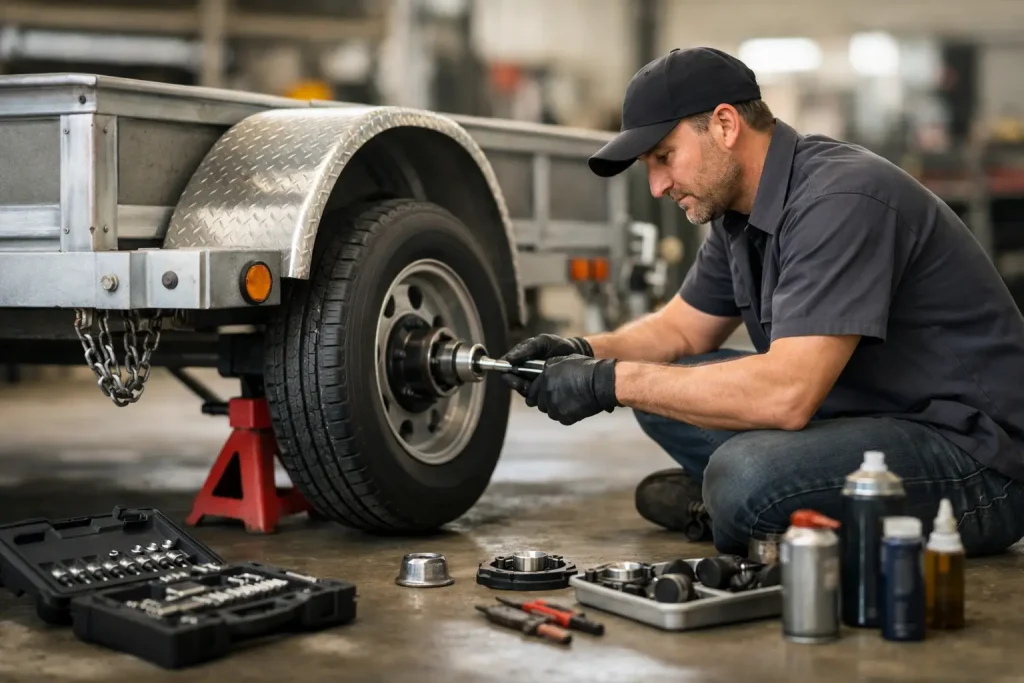
If you want to know how to service a trailer properly, wheel bearings are one of the key areas not to ignore. Bearings carry the load and allow the wheels to turn freely, but they work in a harsh environment. Water, dirt, long storage periods and heavy use all take their toll.
Raise each wheel safely and spin it by hand. Listen for rumbling and feel for roughness. Then check for play by rocking the wheel top to bottom. Some slight movement can be normal depending on the design, but obvious looseness or noise points to adjustment or replacement.
On serviceable bearings, the hub can be removed, the bearings cleaned, inspected and re-greased with the correct high-quality grease before reassembly and adjustment. If the bearing surfaces are pitted, blue from heat or worn, replacement is the sensible choice. Sealed bearing setups may require a different approach, so it is always worth checking the trailer manufacturer’s specification.
Inspect and adjust the brakes
On braked trailers, the braking system needs careful attention. This is one area where guessing is a poor idea. Remove the drums if required and inspect the brake shoes, return springs, cables, expanders and drum condition. Check for contamination, uneven wear and seized components.
Trailer brakes often suffer from underuse as much as overuse. A trailer that sits for months can develop sticking brake parts, while one in regular service may simply wear out its shoes and cables over time. After inspection, the brakes should be adjusted correctly so they apply evenly and release fully. The handbrake should also hold the trailer securely without excessive travel.
If the braking effort feels snatchy, weak or uneven on the road, there may be issues with cable balance, shoe condition or the overrun mechanism. This is where workshop experience really matters, because a trailer can seem acceptable when stationary yet behave poorly under load.
Look at the suspension and axle components
Depending on the trailer design, check rubber suspension units, leaf springs, mounting bolts, U-bolts and axle fixings. Look for perished rubber, sagging ride height, cracked leaves or movement where there should not be any.
Suspension faults often show up as poor tyre wear, instability or a trailer that seems to bounce more than usual. It depends on the trailer type, but once suspension components begin to deteriorate, the handling can change quite noticeably.
How often should you service a trailer?
There is no single answer that suits every trailer. A lightly used domestic trailer may only need an annual service plus regular owner checks, while a trailer used for business, long-distance towing or heavy loads may need more frequent inspection. Usage pattern matters just as much as mileage.
A sensible rule is to inspect the basics before each journey, especially tyres, lights, hitch security and load condition. Then book a more thorough service at suitable intervals based on how often the trailer is used. If it has been standing for months, treat the next outing as a reason for a proper check rather than assuming it will be fine.
The parts owners most often overlook
Many owners focus on what they can see quickly. Lights, tyres and the hitch get a glance, but the less visible parts cause plenty of trouble. Bearings, brake adjustment, damper wear, cable routing and corroded mounting points are easy to miss without a hands-on inspection.
Tyre age is another one. A trailer that covers low mileage can still be running on old tyres that are no longer fit for reliable towing. The same goes for electrics. A plug may work one week and fail the next if the cable is strained or the connections are starting to corrode.
When a DIY check is enough and when it is not
There is nothing wrong with carrying out regular checks yourself. In fact, every trailer owner should. Keeping an eye on tyres, lights, couplings and obvious damage is basic good practice and helps catch issues early.
But when the job involves brakes, bearing replacement, overrun systems, axle work or persistent electrical faults, professional servicing is usually the safer route. The difference is not just tools. It is knowing what normal wear looks like, what needs adjustment, and what should not be put back into service. For many owners, especially those towing for work or heading off with valuable loads, that reassurance is worth having.
At Doncaster Towbars, trailer servicing is approached the same way as towbar and vehicle fitting work – properly inspected, correctly adjusted and focused on safe, dependable use on the road.
A good trailer service saves more than money
Most people think about servicing after something has gone wrong. In reality, the best time to service a trailer is before the season starts, before a long trip or before a busy period at work. That is when you can sort worn parts on your schedule instead of dealing with a failure at the side of the road.
If you use a trailer regularly, treat servicing as part of owning it rather than an extra. A well-maintained trailer tows better, wears its tyres more evenly, puts less strain on the tow vehicle and gives you far more confidence every time you set off. That is the sort of job worth doing properly.