A towbar rarely fails without warning. More often, the signs your towbar needs replacing show up gradually – a bit of movement that was not there before, corrosion spreading around mounting points, or electrics that start behaving unpredictably when you plug in a trailer or caravan. Ignore those early clues and you risk more than inconvenience. You risk unstable towing, uneven loading, poor electrical communication and, in the worst cases, a setup that is no longer safe to use.
For drivers who tow regularly, whether that is a work trailer, horsebox, cycle carrier or caravan, the towbar tends to become part of the background. It is just there, doing its job. But like any load-bearing component on a vehicle, it takes stress, vibration, weather exposure and wear over time. Knowing what to look for can help you deal with problems early, before they become expensive or dangerous.
Signs your towbar needs replacing before it becomes a risk
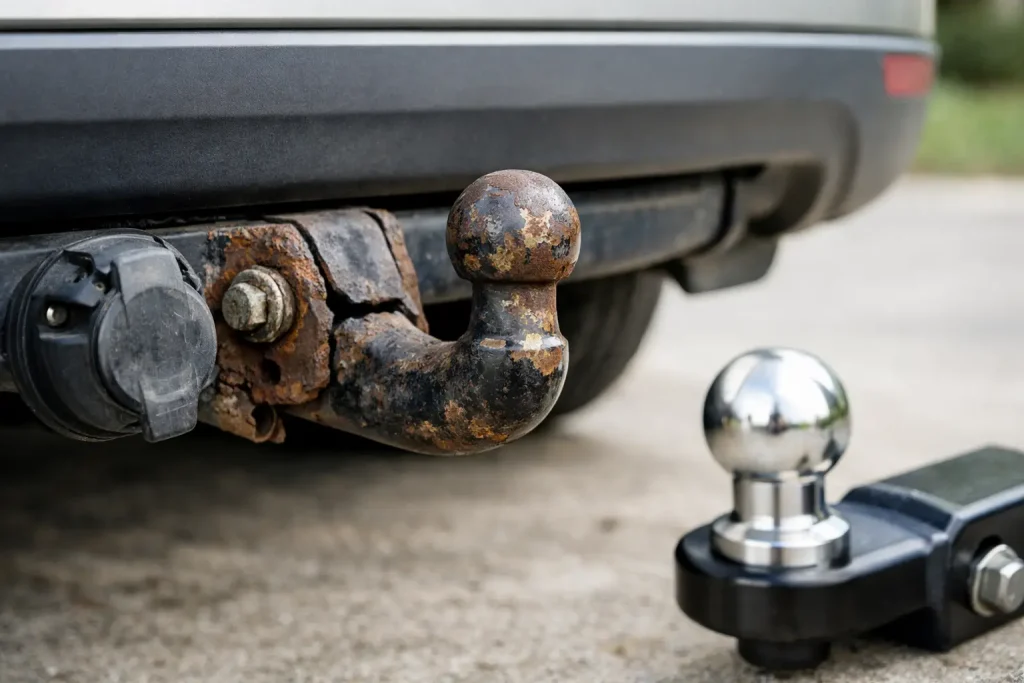
One of the clearest warning signs is visible corrosion. Surface rust on an older towbar is not always a reason to panic, especially on exposed metalwork underneath the rear of the vehicle. But there is a difference between light cosmetic rust and corrosion that is eating into the structure. If the metal is flaking, bubbling, pitting deeply or showing rust around welds, bolts or mounting brackets, the strength of the towbar may already be compromised.
This matters because a towbar does not just support downward nose weight. It also deals with pulling force, braking force and side-to-side movement. Weakness in one area can affect the whole assembly. If corrosion is advanced, replacement is normally the sensible option rather than trying to tidy it up and hope for the best.
Cracks are another serious red flag. These can appear around welds, bends in the metal, fixing points or high-stress areas near the towball mount. Even a small crack can grow once the towbar is put under load again. Sometimes the crack is obvious. Sometimes it is hidden by dirt, rust or old paint. If you notice any split in the metal, stop using the towbar until it has been professionally inspected.
Movement where there should be none is just as concerning. A towbar should feel solidly fixed to the vehicle. If the towball assembly shifts, knocks or feels loose when pressure is applied, something is wrong. That could mean worn bolts, damaged mounting points, metal fatigue or previous overloading. In some cases, the issue may be repairable. In others, especially where the towbar itself has distorted or the mounting area has suffered damage, replacement is the safer route.
Wear, damage and poor towing behaviour
Not every problem is dramatic. Some of the most common signs your towbar needs replacing are subtle changes in how the vehicle and trailer behave together.
You might hear clunking when pulling away or braking. You may notice the trailer feels less settled than it used to, or there is a slight instability that was not there before. That does not always mean the towbar is at fault – trailer loading, tyre pressures and suspension condition all play a part – but it does mean the towbar needs checking as part of the wider picture.
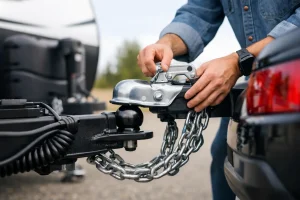
A worn towball is another issue that gets overlooked. Over time, the towball can wear down through repeated coupling and uncoupling, particularly on hard-worked setups. If the surface is heavily scored, flattened, misshapen or worn beyond tolerance, the hitch connection may no longer be as secure as it should be. Some towbar systems allow the towball or detachable neck to be replaced separately. Others may need more involved work, especially if wear is tied to wider damage or corrosion.
Impact damage is also common. Drivers sometimes forget that the towbar is the lowest, most exposed point at the rear of the vehicle. Reversing into a kerb, catching the towbar on a steep ramp or taking a knock in a minor rear-end bump can bend or weaken it. Damage is not always obvious from standing height. A slight twist in alignment or stress around the mounting points can be enough to make towing unsafe.
If your towbar has been involved in any impact, it is worth having it inspected properly rather than assuming it is fine because it still looks attached.
Electrical faults can point to a towbar problem
A towbar is not just metalwork. The electrics matter just as much, particularly on modern vehicles with vehicle-specific wiring, control modules and trailer stability systems.
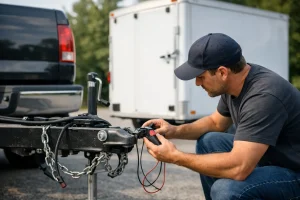
If trailer lights work intermittently, indicators trigger dashboard warnings, or the vehicle does not seem to recognise the trailer correctly, the issue may sit with the wiring, socket or dedicated electrics rather than the towbar itself. That said, recurring electrical faults often appear alongside ageing towbar equipment. Water ingress, corrosion in the socket, damaged pins, poor previous repairs or worn wiring looms can all make the towing setup unreliable.
This is where diagnosis matters. Sometimes the right answer is an electrical repair or socket replacement. Sometimes the faults are part of a bigger picture – an older towbar with deteriorating hardware and electrics that are both past their best. In that case, replacing the full setup can save repeated call-outs and ongoing frustration.
For van owners and tradespeople who rely on towing for work, electrical faults are more than an annoyance. They can stop you using a trailer legally and safely, which quickly becomes downtime you do not need.
Age, usage and previous fitting quality
There is no single lifespan for a towbar. A lightly used towbar on a garaged vehicle may last many years in good condition. A heavily used towbar on a working van that lives outdoors and tows regularly through winter will age much faster. Road salt, moisture, dirt and repeated loading all take their toll.
Previous fitting quality also makes a difference. A properly fitted, vehicle-specific towbar should sit correctly, distribute loads properly and integrate with the vehicle’s towing electrics as intended. Poorly installed towbars can loosen over time, suffer premature wear or create electrical issues that keep coming back.
If you have bought a used vehicle with an existing towbar, it is worth being cautious. You may not know its age, loading history or whether it was fitted to the correct standard. Missing type plates, homemade modifications, non-standard spacers or signs of drilling where there should not be any are all reasons to get it checked.
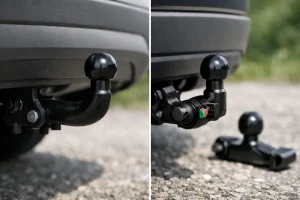
Detachable and swan neck systems need attention too. If a detachable neck is difficult to lock, shows excessive play, or the mechanism is sticking or corroded, do not force it and carry on. Those systems are designed to fit precisely. Once wear or corrosion affects that fit, safe operation becomes questionable.
When repair is enough and when replacement is the right call
This is where experience counts. Not every towbar problem means a full replacement. A socket may be renewed. Fixings may be replaced if caught early and if the surrounding structure is sound. Some detachable components can be changed without replacing the whole assembly.
But there is a point where repairs stop being good value. If the towbar has structural corrosion, cracking, distortion, severe wear or a mix of mechanical and electrical faults, replacing it is usually the better long-term decision. It restores confidence, gives you a setup suited to the vehicle, and reduces the chance of further issues appearing a few weeks later.
For customers towing caravans, trailers or work equipment around Doncaster and the wider area, that peace of mind matters. A towbar should not be something you are second-guessing every time you hitch up.
What to do if you notice signs your towbar needs replacing
If anything looks damaged, loose or heavily corroded, stop towing until it has been checked. That is the simplest and safest advice. Continuing to use a suspect towbar can worsen the problem and increase the risk to your vehicle, trailer and other road users.
A proper inspection should cover the towbar structure, mounting points, towball condition, fixings and electrics. It should also take into account how you use the vehicle. Someone towing a small domestic trailer once a month will not need the same setup as a tradesperson towing loaded equipment through the week.
At Doncaster Towbars, that practical approach matters. The right answer is not always the most expensive one. Sometimes a repair will do the job. Sometimes replacing an ageing or damaged towbar is the safer and more cost-effective choice.
If your towbar has started showing rust, movement, wear or electrical faults, get it looked at before your next trip. It is far easier to sort the problem in the workshop than on the roadside with a trailer you can no longer trust.