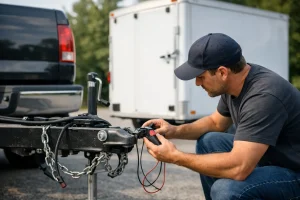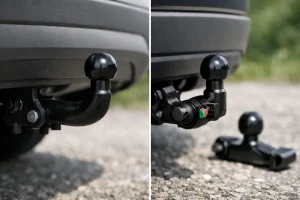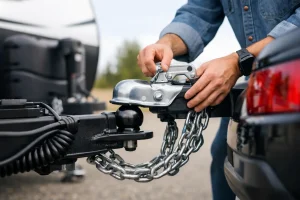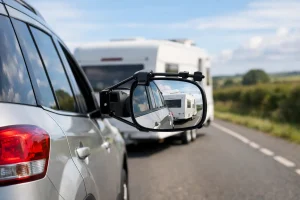
You usually find out the difference between 7 pin vs 13 pin electrics when something does not work. The trailer lights might be fine, but the caravan fridge stays off. Or you have bought a newer trailer and realise the plug on the vehicle does not match. It is a common question in the workshop, and the right answer depends on what you tow, how often you tow, and whether you want a setup that is ready for future use.
For some drivers, a 7 pin system is still perfectly suitable. For others, especially caravan owners or anyone towing newer equipment, 13 pin electrics make more sense straight away. The key is understanding what each system actually does rather than choosing on guesswork.
What is the difference between 7 pin and 13 pin electrics?
At the simplest level, both systems connect your vehicle to the trailer or caravan so the lights and other electrical functions work properly. The difference is in capacity.
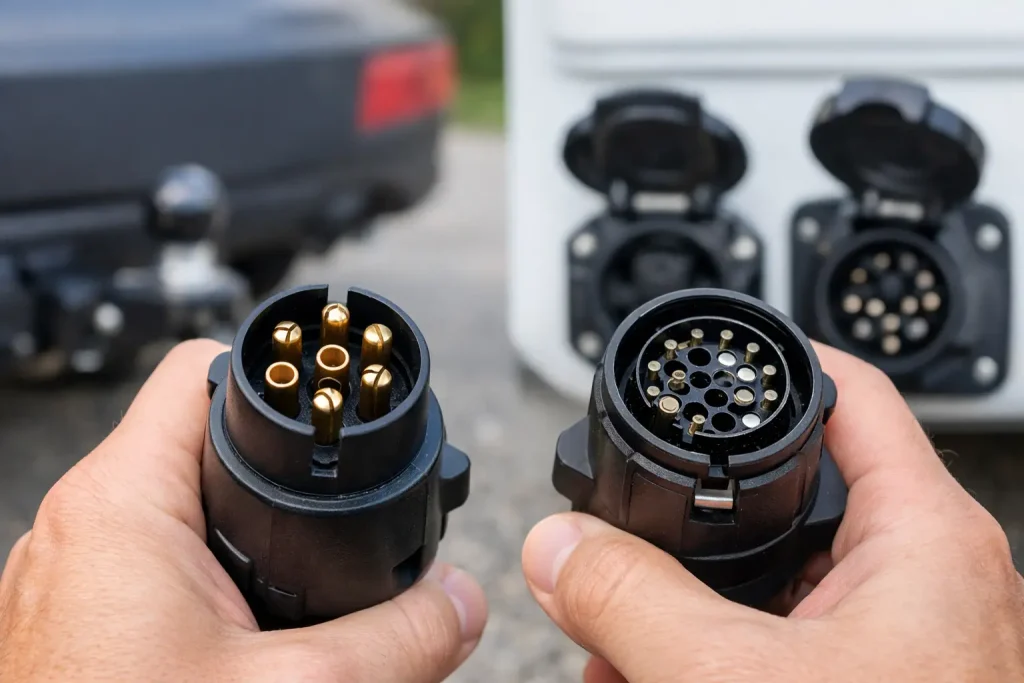
A 7 pin plug is the older and more basic option. It is designed to run the essential road lighting functions for a trailer, including indicators, brake lights, tail lights, fog light and number plate light. If you are towing a small trailer, bike trailer or some older light-duty equipment, that may be all you need.
A 13 pin plug does the same basic lighting job, but it also provides extra circuits. Those added connections can supply reversing lights, permanent power and switched power. That is why 13 pin electrics are commonly fitted for caravans, horseboxes and newer trailers where more than basic lights are required.
In practical terms, 7 pin is simpler, while 13 pin is more complete.
When 7 pin electrics are enough
If your towing is occasional and straightforward, 7 pin electrics can still be the right choice. Many utility trailers, small plant trailers and older trailer setups only need legal road lighting to operate safely. In that situation, paying for additional functions you will never use may not be necessary.
This is often the case for tradespeople using a general-purpose trailer, householders towing to the tip, or customers with an older trailer that already has a 7 pin plug fitted. As long as the trailer only needs the standard lighting circuits, a properly installed 7 pin system will do the job.
That said, there is a limit to what it can support. If you later change to a caravan or a trailer with reversing lights and auxiliary power needs, a 7 pin socket can quickly become restrictive.
When 13 pin electrics are the better option
For many modern towing setups, 13 pin electrics are now the more practical choice. They are especially useful if you tow a caravan, because caravans often need far more than indicators and brake lights. Interior battery charging, fridge operation while driving and reversing lights all rely on those additional circuits.
A 13 pin connection is also generally more secure in use. The plug twists and locks into place, which helps create a firmer connection than the older push-fit 7 pin style. That matters on longer journeys, in poor weather and for anyone who tows regularly.
Even if you do not need every one of those extra functions today, fitting 13 pin electrics can make sense if you want to future-proof the vehicle. It gives you more flexibility if your towing needs change.
7 pin vs 13 pin electrics for caravans
This is the point where the choice becomes much clearer. If you tow a caravan, 13 pin electrics are normally the correct setup.
Older caravans were sometimes connected using twin 7 pin plugs. One plug handled the road lights and the second dealt with supplementary power functions. Modern 13 pin systems effectively combine those functions into one neater, more reliable connection. It reduces clutter, makes connection easier and better suits current caravan wiring arrangements.
If you are comparing 7 pin vs 13 pin electrics specifically for caravan use, 7 pin on its own is rarely enough. It may allow the legal trailer lights to work, but it will not support the full range of caravan electrical features most owners expect.
That does not mean every caravan owner needs a complete vehicle electrical upgrade without discussion. The right fitting depends on the vehicle, the caravan and whether dedicated vehicle-specific wiring is needed. That is why proper advice matters before anything is installed.
Is 13 pin always better?
Not automatically. It is better for many applications, but not every driver benefits in the same way.
If you only ever tow a small garden trailer a few times a year, 13 pin electrics may offer functions you simply will not use. In those cases, a 7 pin system can be a sensible and cost-effective fit. The most important thing is that the electrics are installed correctly, work reliably and suit the trailer being towed.
On the other hand, if you tow frequently, tow different types of trailer, or want your vehicle set up for wider use later on, 13 pin is often the better long-term decision. It gives you more options and reduces the chance of needing changes further down the line.
So yes, 13 pin is more capable. But the best choice still depends on the job.
Adapters – useful, but not always the full answer
Adapters can help when the vehicle and trailer use different plug types. For example, a 13 pin vehicle can be adapted to a 7 pin trailer, and in some cases the other way round. They are useful and often necessary, but they do not create functions that are not already available from the vehicle side.
That is where some confusion comes in. A simple adapter will let you connect different plug formats, but it will not magically give a 7 pin vehicle full caravan auxiliary power. If the underlying electrics are basic, the adapter can only pass on what is already there.
Adapters are best seen as a compatibility tool, not a substitute for the correct electrical installation.
Why proper fitting matters more than the plug type
Whether you choose 7 pin or 13 pin, the quality of the fitting matters just as much as the socket itself. Modern vehicles can be sensitive to electrical work, especially where bulb failure monitoring, parking sensors, stability systems and CAN bus wiring are involved.
A universal wiring kit may be suitable in some cases, while other vehicles are far better served by dedicated vehicle-specific electrics. A correct installation helps ensure trailer lights function properly, warning systems behave as they should and the vehicle remains safe and compliant when towing.
Poor wiring can lead to intermittent faults, warning lights on the dash, battery drain issues or towing functions not operating as intended. That is why it is worth having the setup matched properly to the vehicle and your towing needs rather than choosing on price alone.
How to choose the right setup for your vehicle
The easiest way to decide is to start with what you tow now, then consider what you may tow over the next few years.
If it is a standard small trailer and nothing more, 7 pin may be enough. If it is a caravan, horse trailer, newer trailer with reversing lights, or you want broader compatibility, 13 pin is usually the smarter option. Vehicle type matters too. A family car used for holiday towing may need a different approach from a works van towing equipment every week.
It is also worth checking the trailer or caravan you already own. Matching the vehicle electrics to the actual plug and electrical demands of the trailer avoids unnecessary adapters and reduces the risk of issues on the road.
At Doncaster Towbars, this is exactly the sort of problem we help customers solve every day – not by guessing, but by looking at the vehicle, the trailer and how the setup will be used in real life.
The right answer is the one that fits how you tow
There is no single winner in the 7 pin vs 13 pin electrics debate because both systems still have a place. A 7 pin setup remains suitable for basic trailer lighting and simpler towing jobs. A 13 pin setup offers more functions, better security and is usually the better fit for caravans and modern trailers.
If you are not sure which way to go, it is worth getting advice before fitting anything. The right electrical setup should make towing safer, simpler and more dependable every time you hitch up.