
A failed light board, a worn tyre shoulder or a trailer that starts pulling oddly on the road usually shows up at the worst possible moment – the night before a job, just before a weekend away, or halfway through a busy working week. If you have searched for trailer repair near me, you are probably not browsing out of curiosity. You need a practical fix, and you need to know the trailer will be safe when it goes back on the road.
That matters more than many people realise. A trailer is easy to ignore when it is parked up, but once it is loaded and moving, every worn bearing, weak brake cable and damaged connector starts to matter. Good trailer repair is not just about replacing the obvious broken part. It is about checking the whole setup properly so the fault is fixed, the cause is understood, and you are not back in the same position next week.
What people usually mean by trailer repair near me
Most customers searching for local trailer repairs are dealing with one of two situations. The first is a clear fault such as lights not working, brakes sticking, a puncture, a damaged hitch or uneven tyre wear. The second is less obvious but just as common – the trailer does not feel right. It may bounce more than usual, make noise when towing, feel unstable, or show signs of wear that suggest something is starting to fail.
In both cases, local support matters because trailers are not one-size-fits-all. Small domestic trailers, plant trailers, box trailers, goods trailers and caravan-style running gear all have different demands. A proper workshop will look at the trailer as a working unit, not just a loose collection of parts. That means checking the coupling, overrun assembly, brakes, hubs, bearings, suspension, wheels, tyres, lighting and electrics in context.
Common faults a trailer workshop sees
Trailer problems often build gradually. A light failure may simply be a bad bulb, but it can also point to corrosion in a plug, damaged wiring, a poor earth or water ingress in the lamp unit. Replacing one part without checking the rest can leave you with the same fault returning the next time the weather turns.
Brake issues are similar. If trailer brakes are snatching, binding or not operating evenly, the problem may sit in the cables, linkage, drums, shoes or adjustment. Sometimes the overrun mechanism itself is worn. Sometimes the trailer has been standing too long and components have seized. There is no single answer that suits every trailer, which is why diagnosis matters.
Tyres and running gear also cause regular trouble. Cracks in sidewalls, flat spots from storage, damaged rims and worn bearings are all common on trailers that cover low annual mileage but spend a lot of time parked up. Low mileage does not always mean low wear. Age, storage conditions and loading habits all make a difference.
Why local workshop repairs beat quick patch jobs
When people search for trailer repair near me, they are often trying to save time. That makes sense, but the fastest option is not always the best one if it only deals with the symptom. A quick roadside-style patch might get a trailer moving again, but workshop repairs allow for proper inspection, safer testing and more reliable parts replacement.
A workshop can also spot related issues before they become expensive. For example, a trailer brought in for lighting faults may also show cracked plug wiring, worn tyres and play in the wheel bearings. Catching those items early is cheaper and safer than waiting for a breakdown or MOT-style failure point later.
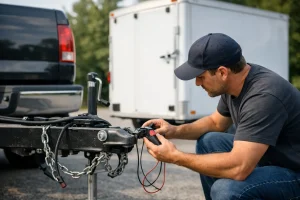
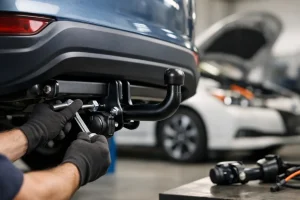
There is also the question of towing compatibility. Electrical faults are not always on the trailer itself. Sometimes the issue lies with the vehicle socket, trailer electrics setup or previous wiring work that has not been done correctly. A business that understands both trailers and towbar electrics has a clear advantage here because it can check the full towing connection rather than guessing at one side of it.
What a proper trailer repair should include
A good repair process starts with listening. If the trailer sways at speed, knocks over bumps, pulls under braking or loses lights intermittently, those symptoms help narrow the fault quickly. From there, the trailer should be inspected methodically rather than by trial and error.
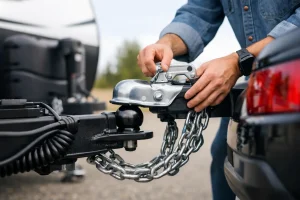
That usually means checking wheel bearings for play and roughness, assessing tyre condition and age, examining brake operation and adjustment, inspecting cables and linkages, looking over the hitch and coupling for wear, and testing all lights and electrical connections. On some trailers, floor condition, body mounts and load-bearing points also need attention.
The right repair then depends on what the inspection shows. Sometimes the answer is straightforward and cost-effective. Sometimes several worn parts need dealing with together because replacing only one would be false economy. That is where honest advice matters. A dependable workshop should tell you what needs doing now, what can be monitored, and what may be worth budgeting for if the trailer is used heavily.
Trailer servicing and trailer repairs go hand in hand
Many breakdowns could be avoided with routine servicing. That is especially true for trailers used seasonally, such as camping, leisure or occasional business trailers. They often sit idle for long periods, then are expected to work hard straight away. Brakes stick, bearings dry out, tyres age, and electrical connections corrode quietly in the background.
Regular servicing helps prevent that cycle. It gives you a chance to inspect wear items, keep brakes adjusted, confirm lights are working properly and spot ageing parts before they become a safety issue. For tradespeople and business users, it also reduces avoidable downtime. A trailer off the road can quickly disrupt deliveries, site work or planned jobs.
If your trailer sees regular use, servicing should be treated as part of running costs rather than an optional extra. If it only comes out now and then, it still needs checking before a long trip or a loaded journey. Standing still is not the same as staying in good condition.
Choosing the right place for trailer repair near me
Not every garage wants to deal with trailer work, and not every general mechanic has the parts knowledge or towing background to diagnose faults properly. That is why searching for local trailer specialists usually gets better results than simply finding the nearest workshop with a ramp.
You want a business that is used to working on towing systems, trailer electrics, couplings, brake assemblies and related vehicle-side connections. Practical experience matters because many trailer faults are not complicated in theory, but they are easy to misdiagnose if you do not see them regularly.
It also helps to choose a workshop that can support more than one part of the problem. If your trailer lights are not working, the issue may be in the trailer plug, the board, the socket, the towbar wiring or the vehicle electrics. A specialist such as Doncaster Towbars can approach that sensibly because trailer support and towing electrics sit under the same roof.
Local repair makes sense when safety is on the line
There is a temptation to put trailer faults off for another week, especially if the trailer still rolls, still couples up and still looks usable. That is often when small faults become costly ones. A noisy bearing becomes a failed hub. Weak brakes become dangerous stopping distances. A bad earth becomes full lighting failure on a wet evening.
Getting the trailer checked locally means you can deal with problems before they interrupt work or spoil a trip. It also gives you confidence that the trailer is roadworthy, balanced and safe to tow with your vehicle. That confidence matters whether you are hauling tools for work, moving equipment, towing a camping trailer or simply trying to get through a busy week without avoidable setbacks.
If you are looking for trailer repair near me in Doncaster or the surrounding area, the best step is a proper inspection by a workshop that understands towing from both sides – trailer mechanics and vehicle electrics. A clear fault can often be sorted quickly, but the real value is knowing the rest of the trailer has been checked properly too. When a trailer is carrying weight behind your vehicle, guesswork is never worth it.