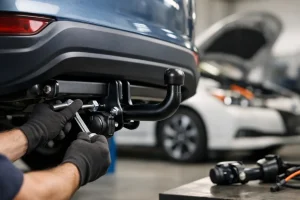

A towbar can look like a simple bit of kit until you order the wrong one, turn up for fitting, and realise it does not suit the vehicle, the trailer or the way you actually use it. If you are wondering how to choose a towbar, the right answer starts with what you plan to tow, how often you will tow it, and how your vehicle is wired.
For some drivers, a towbar is there for the odd trip to the tip with a small trailer. For others, it is for a caravan, a bike carrier, plant equipment or daily work use. Those jobs do not all need the same setup. Choosing properly at the start saves hassle later and gives you a safer, more reliable towing setup.
How to choose a towbar without guessing
The biggest mistake people make is choosing by appearance or price alone. A cheaper towbar may not be the best option if it limits access, does not suit your towing pattern, or needs extra work to function properly with the vehicle’s electrics.
The first thing to check is your vehicle’s towing capacity. This tells you the maximum weight the vehicle can legally tow, along with the noseweight limit, which is the downward force allowed on the towball. That matters whether you are towing a loaded trailer or fitting a cycle carrier. There is no point fitting a towbar designed for heavy-duty use if the vehicle itself has lower limits.
You also need to think about whether the towbar will be used regularly or occasionally. A tradesperson towing through the week will usually value strength, simplicity and quick access. A private motorist who mainly wants a clean look when not towing may prefer a removable or retractable option.
The main towbar types
Most customers are deciding between a fixed towbar, a detachable towbar or a retractable towbar. Each has its place.
Fixed towbars
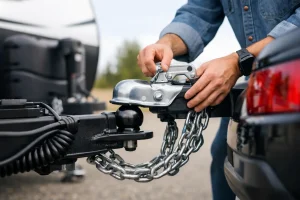
A fixed towbar stays in place all the time. It is usually the most straightforward and cost-effective option, and for regular towing it makes a lot of sense. If you tow a trailer for work, move machinery, or use a caravan frequently, fixed towbars are often the practical choice. They are always ready to go and there are no extra parts to remove or store.
The trade-off is appearance and rear access. Some drivers do not like seeing the towbar permanently fitted, and on some vehicles it can interfere with parking sensors if the setup is not chosen and installed properly.
Detachable towbars
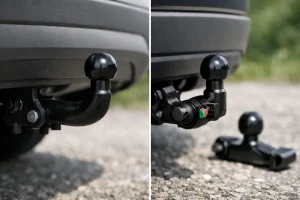
A detachable towbar gives you the option to remove the towball when it is not in use. That keeps the rear of the vehicle looking tidier and can be useful if you only tow from time to time.
This type suits drivers who want towing capability without a permanent towbar on show. It is popular with newer cars and SUVs where owners want a neater finish. The trade-off is cost, and you do need to keep track of the detachable neck and fit it correctly when needed.
Retractable towbars
A retractable towbar folds away behind the bumper when not in use. It is the most discreet option and often the most convenient in terms of appearance.
It is also usually the most expensive. For some owners that extra cost is worth it, especially on premium vehicles. For others, a detachable towbar gives a similar result for less money. This is one of those cases where it depends on how much you value convenience and a factory-style finish.
Matching the towbar to what you tow
The right towbar for a small domestic trailer is not always the right one for a caravan or a work van setup. Before choosing, be clear about what the towbar will actually be doing.
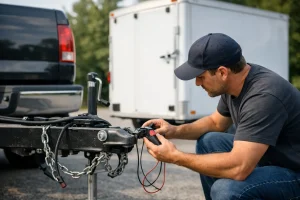
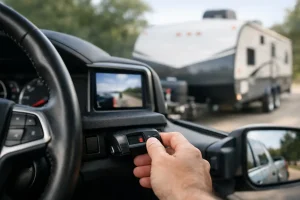
If you tow a caravan, electrics are a big part of the decision. Caravan towing often needs functions such as road lights, interior power supply or fridge operation depending on the age and type of caravan. If you are towing a standard trailer, a simpler electrical setup may be enough.
If you are using a towbar for a bike carrier, noseweight matters just as much as towing capacity. Some people assume that because they are not pulling a trailer, any towbar will do. That is not always the case. The combined weight of the carrier and bikes must stay within the vehicle and towbar limits.
For commercial vans and work vehicles, durability and frequency of use tend to matter more than looks. A fixed towbar is often the sensible option, but it still needs to be vehicle-specific and professionally fitted, especially where modern van electrics are involved.
Do not overlook trailer electrics
A lot of the real decision-making sits in the wiring. Modern vehicles are far more complex than they used to be, and universal wiring kits are not always the best answer. Vehicle-specific electrics are often the safer and more reliable option because they are designed to communicate correctly with the car’s own systems.
That can affect everything from trailer lighting to bulb failure warnings, stability systems and parking sensor behaviour. On some vehicles, coding or programming is needed after fitting so the car recognises the towing system properly.
7-pin or 13-pin?
For basic trailer lighting, a 7-pin socket may be enough. If you are towing a caravan or a trailer that needs additional power functions, a 13-pin socket is often the better choice.
This is where a quick conversation with an experienced fitter helps. There is no benefit in paying for a more complex setup than you need, but there is also no point fitting the wrong socket and having to adapt or upgrade later.
Vehicle design matters more than many drivers expect
Two vehicles from the same manufacturer can need very different towbar and electrical solutions. Bumper design, parking sensors, crash structures and onboard electronics all affect what can be fitted and how it should be installed.
That is why vehicle-specific fitting matters. A towbar should not be treated as a one-size-fits-all product. Proper installation means the towbar is matched to the exact make, model and year of the vehicle, with the correct mounting points, electrics and coding where required.
It also means the fitter can advise on practical points such as whether bumper cuts are needed, whether the socket can be tucked away neatly, and how the towbar will sit once fitted.
Price matters, but value matters more
It is natural to compare quotes, but the cheapest option is not always the best value. A towbar fitting price may vary because of the towbar type, the electrical kit, the amount of labour involved, and whether coding is required.
A low headline figure can sometimes leave out important elements such as vehicle-specific electrics or proper integration with the vehicle’s systems. That can lead to faults, warning lights, sensor issues or unreliable trailer connections.
A better approach is to ask what is included. Are the electrics vehicle-specific? Is coding part of the job if needed? Is the towbar suitable for your intended use? Those details make a real difference to long-term reliability.
How to choose a towbar if you are not sure what you need
If you are undecided, start with three simple questions. What are you towing? How often are you towing it? Do you want the towbar visible all the time?
Those answers narrow things down quickly. Regular towing usually points towards a fixed towbar. Occasional towing with a preference for a cleaner look often points towards a detachable model. If appearance matters most and budget allows, retractable may be the right option.
The next step is checking the vehicle details and the electrical requirements. That is where professional advice earns its keep. A good fitter will not just sell you a towbar. They will match the product and wiring to the vehicle and the job it needs to do.
At Doncaster Towbars, that usually starts with a straightforward chat about the vehicle, the trailer or caravan, and how the towbar will be used day to day. That practical approach tends to prevent the common problems that come from ordering on guesswork.
Professional fitting makes the difference
Even the best towbar is only as good as the way it is fitted. Correct torque settings, secure mounting, proper wiring and system checks all matter. With modern vehicles, this is not just a mechanical job. It is an electrical one too.
Professional fitting gives you confidence that the setup is safe, compliant and built around your specific vehicle. It also means any extras, such as parking sensors or trailer fault finding, can be looked at properly rather than treated as separate problems.
If you are choosing a towbar, think beyond the part itself. Think about the vehicle, the wiring, the trailer, and how you will use it in real life. Get those details right and towing becomes simple for all the right reasons. If you are unsure, speak to a specialist and get advice based on your vehicle, not a generic product listing.