A trailer that starts to hum, wander or run unusually hot can turn a straightforward journey into a costly recovery. Trailer wheel bearing replacement is one of those jobs that is easy to put off when the trailer is still moving, but bearings work under constant load and rarely improve with use. Catching wear early protects the hub, axle and tyres, as well as the load behind your vehicle.
Whether you tow a caravan, box trailer, plant trailer or working trailer around Doncaster and South Yorkshire, the principle is the same: the wheel must turn freely, sit securely on the axle and remain correctly lubricated. If there is any doubt, a proper inspection is the sensible place to start.
The warning signs your trailer should not ignore
Bearing problems are not always dramatic at first. A faint rumble can be mistaken for tyre noise, while excessive play may only be found during a routine check. The most useful warning signs are a humming, grinding or droning noise from one wheel, a hub that feels much hotter than the others after a short run, grease appearing around the inside of the wheel, or noticeable movement when the wheel is rocked from top to bottom.
You may also see uneven tyre wear, although this can have other causes such as axle alignment, suspension wear or incorrect tyre pressures. A wheel that does not rotate smoothly when raised off the ground deserves attention, particularly if it feels notchy or makes a metallic sound.
Do not rely on a visual check alone. A bearing can look clean from the outside while the rollers, races or seal inside the hub are deteriorating. Equally, old grease may hide contamination until the hub is dismantled.
Why wheel bearings fail
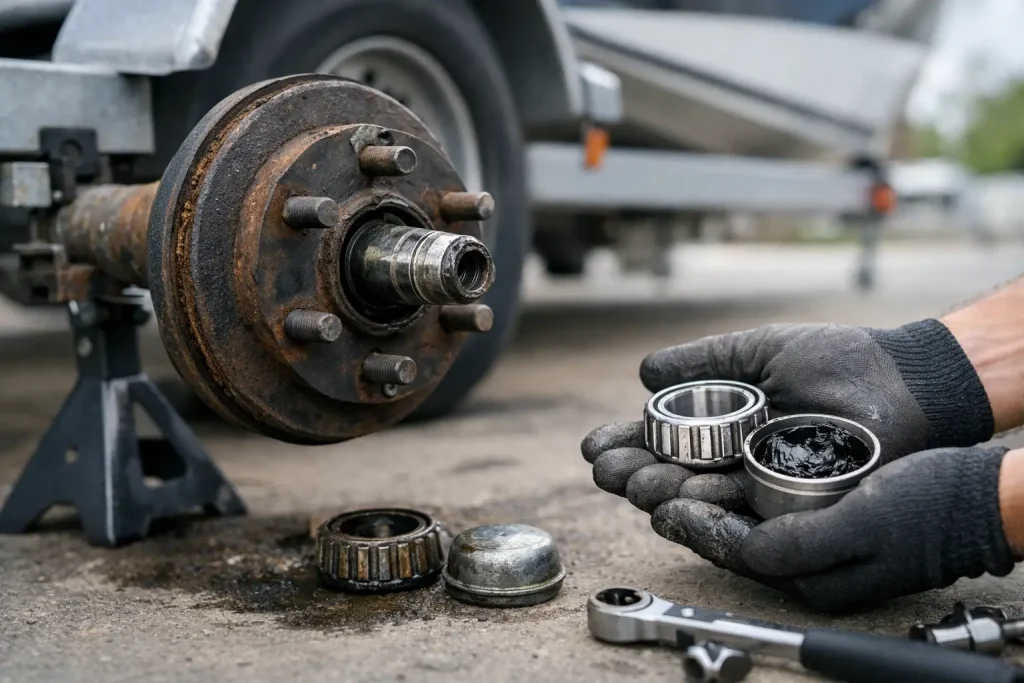
Most trailer hubs use tapered roller bearings, packed with grease and protected by a seal. Over time, heat, water ingress, dirt, age and heavy loading break down that protection. Once grease loses its condition or water gets into the hub, corrosion and pitting can begin on the bearing surfaces.
Overloading is another common cause. A trailer may be within its apparent capacity but still place too much weight on one axle or one side. Long motorway journeys, repeated stop-start towing and regular use on poor surfaces all add heat and stress. Trailers that sit unused for months are not automatically protected either. Seals can harden, moisture can collect and the grease can deteriorate.
Incorrect adjustment after previous work is also a factor. Bearings that are too tight run hot; bearings that are too loose allow damaging movement in the hub. This is why the job is about more than simply adding grease.
When does trailer wheel bearing replacement make sense?
A bearing inspection may show that cleaning, repacking and adjustment are suitable, but replacement is usually the better value option when there is roughness, corrosion, blue heat marks, pitting, damaged rollers or clear play. If a bearing has run hot, do not assume fresh grease will solve it. Heat can damage the bearing steel and compromise the seal.
It is generally wise to replace the bearing and its matching race as a set, along with the grease seal. Reusing a worn race with a new bearing can shorten the life of the new component. If one hub has failed because of age, contamination or missed maintenance, the bearing on the other side of that axle should be inspected carefully too. It may not always need replacement, but it should not be ignored.
The correct parts depend on the trailer axle, hub and braking arrangement. Similar-looking bearings can have different dimensions and load ratings, so fitting parts by appearance alone is a risk. A professional service identifies the parts correctly before fitting them.
What a proper bearing replacement involves
A thorough trailer wheel bearing replacement begins with safely supporting the trailer and removing the wheel and hub assembly. The condition of the old grease, seal, bearings and races provides valuable clues about what has gone wrong. A milky grease colour can point to water contamination, while scorched grease or blue discolouration suggests overheating.
The hub is cleaned properly before new races are installed. New bearings are packed with the correct high-temperature wheel bearing grease, fitted with a fresh seal and adjusted to the manufacturer’s specification. The hub must turn freely without excessive end float, then the wheel is refitted and tightened correctly.
On a braked trailer, it is also a sensible time to inspect the brake shoes, drums, cables and adjusters. There is little benefit in restoring the hub only to discover a brake component is binding or worn. For commercial and heavily used trailers, this joined-up approach can prevent unnecessary downtime.
At Doncaster Towbars, trailer servicing and repairs are handled with the wider condition of the trailer in mind, not as a quick parts swap. That means checking the hub area carefully and raising any concerns before they become a bigger issue on the road.
Can you replace trailer bearings yourself?
A competent owner with the right tools, clean working area and accurate technical information can carry out bearing work. However, it is not the best first-time job to learn through trial and error before a holiday or a working week of towing. Correct removal and installation of races, grease packing, seal fitting and bearing adjustment all matter.
The main risk is not simply fitting the wrong bearing. Damage can be caused by driving a race in unevenly, contaminating fresh grease, overtightening the hub nut or leaving too much movement. Some hub nut arrangements use specific tightening and locking methods, so a generic torque figure should never be guessed.
If you have noticed heat, noise, looseness or grease leakage, booking an inspection is often the safer and more economical route. A seized bearing can damage the stub axle or hub beyond a simple serviceable repair, and in severe cases can lead to wheel loss.
Simple checks between services
Regular checks take only a few minutes and are particularly worthwhile before a long journey. With the trailer securely parked, look at the tyres for uneven wear and check that wheel nuts are secure. Raise each wheel safely when practical and spin it by hand, listening and feeling for roughness. Then rock the wheel gently to check for excessive play.
After towing, carefully compare hub temperatures between wheels. Do not touch a hub that may be hot enough to burn. If one hub is noticeably hotter than the others, allow it to cool and arrange an inspection before using the trailer again. A temperature difference is often more revealing than an absolute temperature.
Keep the trailer’s loading balanced, stay within its plated weights and avoid directing a pressure washer at hub seals. Grease caps and bearing protectors can help in certain applications, but they are not a substitute for scheduled servicing. Adding grease without knowing the condition of the bearings can force old grease past a seal or conceal an existing problem.
When to stop towing immediately
Stop as soon as it is safe to do so if you hear loud grinding, smell burning grease, see smoke near a wheel, find grease sprayed around the hub, or feel a strong vibration through the tow vehicle. Do not continue slowly in the hope of reaching home or a job site. A deteriorating bearing can fail quickly once it has overheated.
Arrange recovery or professional assistance where needed, especially if the wheel has visible movement, the hub is extremely hot or the trailer is carrying a heavy load. Protecting the axle and keeping other road users safe is worth far more than trying to complete one journey.
A well-maintained trailer should feel quiet, stable and predictable behind the vehicle. If yours has started to feel different, treat that change as useful information. A timely bearing check gives you confidence for the next trip and helps keep your trailer ready for the work, weekends and journeys you rely on it for.