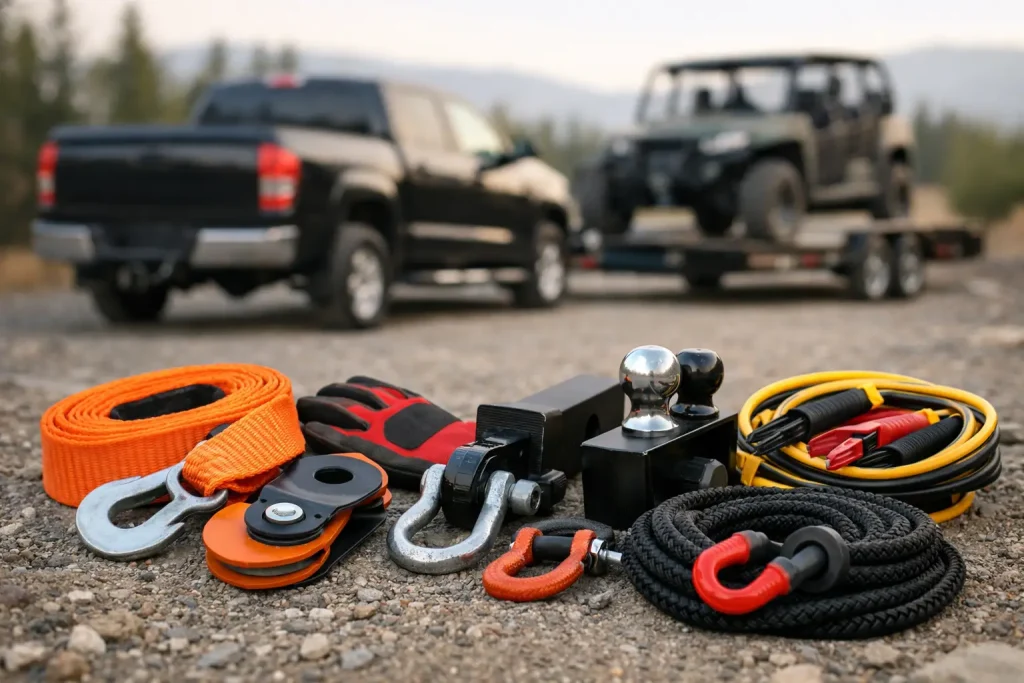
Your first towing trip should not begin with a last-minute search for a breakaway cable or a set of mirrors at a petrol station. The best towing accessories for beginners are the ones that make the vehicle, trailer and driver work safely together – not simply the ones that look useful in the boot.
A correctly fitted towbar and suitable vehicle-specific electrics come first. Once those foundations are in place, a small number of well-chosen accessories will make hitching, loading, reversing and checking your outfit far less stressful. What you need depends on whether you are pulling a small utility trailer, caravan, horsebox or work trailer, but the essentials below apply to most first-time towers.
1. Towing mirrors
Towing mirrors are one of the first accessories many beginners need, particularly when towing a caravan or wide trailer. If the trailer is wider than your vehicle, your normal door mirrors may not give you an adequate view along both sides and behind the trailer.
Choose mirrors that fit firmly to your existing wing mirrors without blocking the standard mirror glass. Strap-on and clamp-on versions are common, but the best option is one that remains stable at motorway speeds and does not vibrate so much that the view becomes unusable.
Before setting off, adjust them on level ground. You should be able to see down each side of the trailer and spot vehicles approaching from behind. Do not treat towing mirrors as an optional extra for a long journey. Clear rearward vision makes lane changes, roundabouts and reversing safer from the outset.
2. A breakaway cable or secondary coupling
The right safety connection depends on the type of trailer you tow. A braked trailer requires a breakaway cable, which activates the trailer brakes if it becomes detached from the towing vehicle. An unbraked trailer generally uses a secondary coupling, such as a safety chain or cable, to help keep it attached if the hitch fails.
This is a small item with a major job. The cable should be in good condition, free from fraying or kinks, and connected in the correct way for your towbar and trailer. It must not drag on the ground, wrap around the towball or be so short that it pulls tight on full lock.
If you are unsure whether your trailer is braked, or how its safety cable should be fitted, ask before you tow. Guesswork at the hitch is never worth the risk.
3. A towball cover and hitch cover
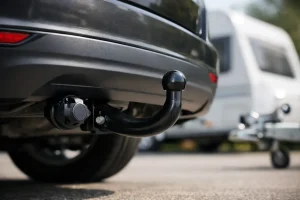
A towball cover is inexpensive, but it helps keep grease, grit and road salt off the towball when it is not being used. This is especially worthwhile if you have a detachable towbar and want to keep the mechanism clean between trips.
A hitch cover protects the trailer coupling from rain and dirt while the trailer is parked. It can also reduce the amount of grime transferred to your hands and clothes when hitching up. Neither cover replaces cleaning and inspection, but both make routine care easier.
Be aware that some stabiliser hitches need a clean, dry, grease-free towball to work properly. Always follow the hitch manufacturer’s guidance rather than applying grease automatically.
4. A 13-pin electrical adaptor, if needed
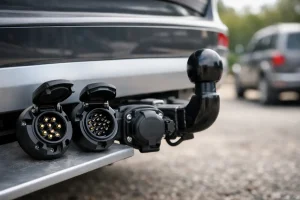
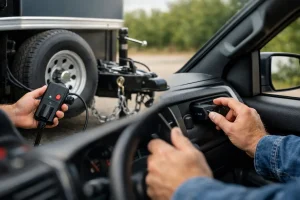
Modern vehicle towing electrics commonly use a 13-pin socket, while some older trailers have twin 7-pin plugs or a single 7-pin system. An adaptor can bridge that gap, but it needs to match the trailer’s plug arrangement and support the functions you need.
Lights are not an area to compromise on. Before every journey, check indicators, brake lights, tail lights, fog light and number plate illumination. If you tow a caravan, you may also need power for internal functions, depending on its wiring and your vehicle’s electrical system.
A professionally installed, vehicle-specific wiring kit is preferable to a basic universal setup on many modern cars and vans. It communicates correctly with the vehicle and can support towing-related safety systems. Doncaster Towbars can advise on the right electrics for both the vehicle and the trailer rather than leaving you to work around an unsuitable plug.
5. A noseweight gauge
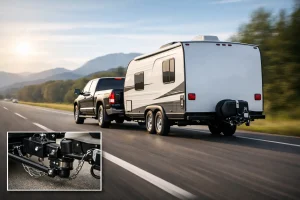
Noseweight is the downward force imposed by the trailer coupling on the towbar. Too little can make a trailer unstable; too much can overload the vehicle or towbar. A simple noseweight gauge gives you a practical way to check it before a trip.
Check the permitted noseweight for your vehicle, towbar and trailer, then work to the lowest figure. The actual weight needs to stay within that limit. This is not just a matter of moving a heavy item from front to back: load distribution affects how the trailer behaves on the road.
As a general rule, heavier items should sit low and close to the trailer axle, securely restrained. Avoid loading everything at the rear, and do not assume a trailer is balanced because it looks level.
6. A tyre pressure gauge and portable inflator
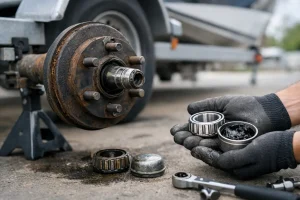
Trailer tyres often get overlooked because they cover fewer miles than car tyres. Yet a trailer can sit for weeks or months before use, losing pressure slowly or developing age-related damage. Underinflated tyres run hotter, affect stability and can fail under load.
Keep a reliable tyre pressure gauge in the vehicle and check pressures when tyres are cold. A compact portable inflator is useful for topping up before departure, although it is not a substitute for repairing a puncture or replacing a damaged tyre.
Check the tyre sidewalls too. Look for cracks, bulges, cuts and uneven wear, and confirm that the tyres have adequate tread. Do not forget the spare wheel if the trailer has one. A spare that is flat, perished or missing its wheel brace will not help beside the road.
7. Wheel chocks and a levelling aid
Wheel chocks are particularly useful when loading, unloading or unhitching on a slope. They help prevent the trailer from rolling while you are working around it. Choose sturdy chocks sized appropriately for the trailer wheels, and use them on firm ground.
For caravans and box trailers, a levelling ramp can also be worthwhile. It makes it easier to park evenly and can help with using appliances in a caravan. It is not essential for every occasional trailer user, but it is a sensible addition if you regularly stop on uneven ground.
Never rely solely on the trailer handbrake when loading on an incline. Chocks add a simple layer of control when you need it most.
8. A hitch lock and wheel clamp
A trailer is easy to steal if it is left unsecured on a drive, yard or storage site. A hitch lock prevents the coupling from being attached to another vehicle, while a wheel clamp makes the trailer harder to move.
For a small domestic trailer, a good-quality hitch lock may be enough for short periods. For caravans, plant trailers and work trailers containing tools or equipment, use layered security. A hitch lock and wheel clamp together offer more protection than either item alone.
Make sure the lock fits your specific hitch. A poorly fitting lock is frustrating to use and may give a false sense of security. Keep keys somewhere separate from the trailer keys and avoid leaving the lock loose in the trailer when travelling.
9. Reversing aids for confidence at the hitch
Reversing a trailer is a learned skill, and beginners often find the pressure of a busy car park or campsite more difficult than towing on the open road. A reversing camera, parking sensors or a simple trailer guide can make manoeuvring less intimidating.
A camera gives you a better view of the towball when lining up to hitch and can help identify obstacles behind the vehicle. It will not show every blind spot, so use mirrors and get out to check when needed. If someone is guiding you, agree clear hand signals before you start moving.
For regular towing, fitted parking sensors and a dash cam can also be useful additions to the vehicle. They do not replace observation or careful control, but they can make everyday manoeuvres and incident recording more straightforward.
Choose accessories around your actual trailer
It is easy to buy too much before the first trip. Start with the items that address safety, legal visibility and basic checks: suitable mirrors, the correct safety cable, working electrics, tyre equipment and a way to confirm noseweight. Add security and manoeuvring aids based on where you store the trailer and how often you tow.
Before each journey, walk around the full outfit. Check the coupling is properly engaged, the breakaway cable or secondary coupling is connected, lights work, tyres are sound, the load is secure and the jockey wheel is fully raised. That two-minute routine builds good habits quickly.
The most useful accessory for a new tower is confidence based on proper preparation. If the towbar, electrics or trailer setup does not feel right, get it checked by experienced technicians before setting off – a calm first journey starts well before the engine does.