A trailer fault rarely appears at a convenient time. It is usually found when the caravan is packed, the job needs doing, or you are about to set off for a weekend away. Knowing how to diagnose trailer faults methodically can prevent a roadside stop, an MOT failure, or a dangerous journey with lights, brakes or safety equipment not doing their job.
The key is not to guess. Start by separating the trailer from the towing vehicle, check the obvious mechanical and electrical causes, and only then decide whether the repair is safe to carry out yourself. A loose bulb holder is one thing. Damaged wiring, a braking fault or a worn coupling needs proper attention before the trailer goes back on the road.
Diagnose trailer faults by isolating the cause
Most trailer problems fall into two groups: electrical faults and mechanical faults. Electrical issues tend to show up as lights that do not work, flash too quickly, dim when another light is switched on, or behave unpredictably. Mechanical faults are more likely to involve the hitch, brakes, wheel bearings, tyres, suspension or loading.
Before investigating, park on level ground, apply the towing vehicle handbrake, chock the trailer wheels if necessary and make sure the trailer is uncoupled only when it is stable. Never work beneath a loaded trailer supported only by a jack.
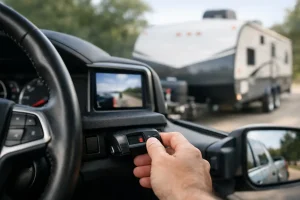
A simple first test can save time. Connect the trailer to the vehicle, switch on each lighting circuit in turn and have somebody stand behind the trailer. Check sidelights, brake lights, indicators, fog lamp, reversing lamp where fitted, and number plate light. Then repeat the test using a known-good trailer board or another compatible towing vehicle if available. This quickly helps establish whether the problem is on the trailer or in the vehicle socket and towing electrics.
Start with the plug, socket and fuses
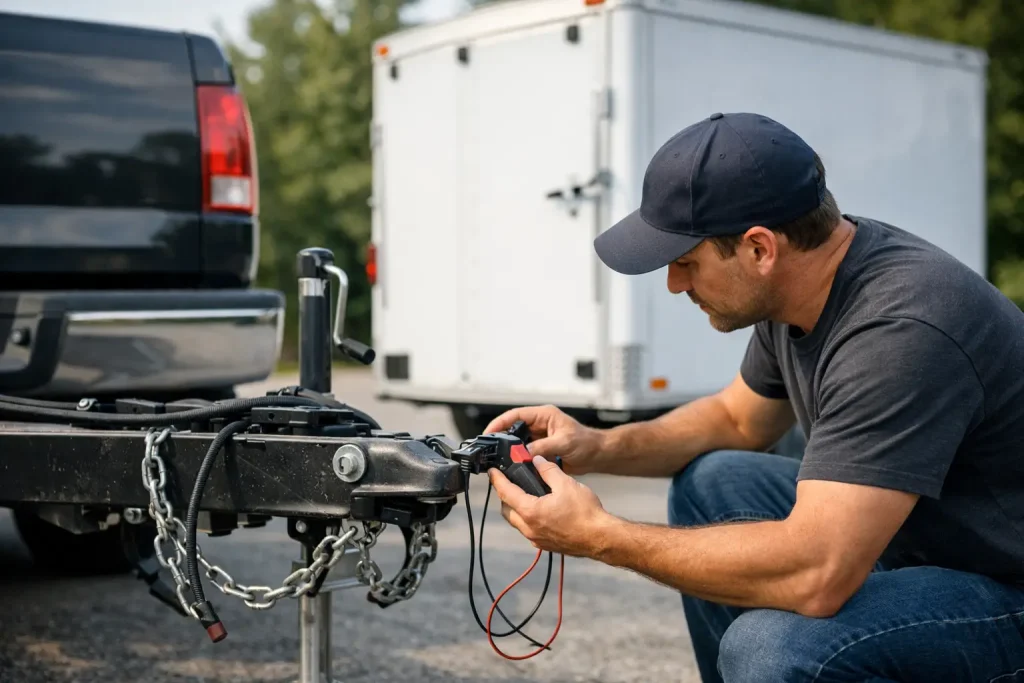
A large number of lighting faults begin at the connection point. Look for bent pins, green corrosion, moisture, dirt, loose terminals or a plug that does not lock firmly into place. A 7-pin or 13-pin plug can look acceptable from the outside while a wire has pulled loose inside the housing.
Check the towing vehicle’s relevant fuses too. Modern vehicles often use vehicle-specific electrics or a dedicated control module. If a fuse has failed repeatedly, do not simply replace it and carry on. Repeated failure suggests a short circuit, water ingress or damaged wiring that needs tracing.
If you use an adaptor between 7-pin and 13-pin systems, test without it where possible. Adaptors are useful, but another connection adds another possible point of failure, particularly when used regularly in wet and dirty conditions.
Check the earth before replacing parts
Poor earthing causes some of the most confusing trailer light faults. A weak earth can make an indicator flash through another lamp, leave lights dim, or cause a brake light to affect the sidelights. It is tempting to replace bulbs first, but that often treats the symptom rather than the cause.
Inspect the earth wire and its fixing point to the trailer chassis. The connection should be clean, tight and free from paint, corrosion and grease. On older trailers, corrosion around lamp units and chassis earth points is common. A multimeter can help confirm continuity, but a visual inspection still matters because a cable may be corroded inside its insulation.
Inspect bulbs, lamp units and cable runs
Check that every bulb is the correct type and fitted securely. A bulb with a damaged filament, blackened glass or loose contacts should be replaced. LED lamps require a slightly different approach: a failed LED unit is often replaced as a complete assembly, and some vehicle systems need compatible LED trailer electrics to avoid warning messages or false fault indications.
Follow the wiring along the trailer chassis, especially where it passes through clips, enters a lamp housing, crosses a moving drawbar or sits near sharp metal edges. Look for crushed insulation, repairs wrapped in tape, exposed copper and cable that hangs low enough to catch debris. Water can travel along cable runs and collect inside connectors, so inspect any joins carefully.
Common mechanical faults to check before towing
A trailer can have perfect lights and still be unsafe. Mechanical checks are particularly important after a long period of storage, following a kerb strike, or before a heavily loaded trip.
Coupling, jockey wheel and safety cable
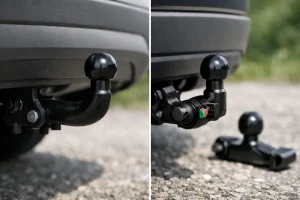
The coupling should close fully onto the towball and show a positive engagement indication where one is fitted. Check for excessive play, damage, cracking or stiffness. Make sure the towball itself is clean and suitable for the coupling type. Grease in the wrong place can affect certain stabiliser couplings, so follow the trailer manufacturer’s guidance rather than assuming every hitch should be lubricated.
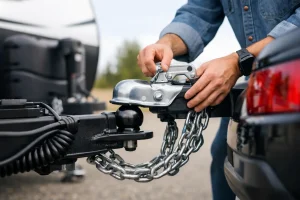
Raise the jockey wheel fully before towing and secure it properly. A loose or low jockey wheel can strike the road surface. On a braked trailer, inspect the breakaway cable for fraying, kinks, corrosion or an unsuitable attachment point. It must be connected correctly so that it can apply the trailer brakes if the trailer becomes detached, without dragging or snagging during normal turns.
Brakes, bearings and wheels
If a braked trailer feels difficult to move by hand, pulls to one side, jerks when slowing down or becomes hot around a wheel, stop using it until it has been inspected. These signs can point to seized brakes, an overrun mechanism problem, incorrectly adjusted brake cables or a bearing issue.
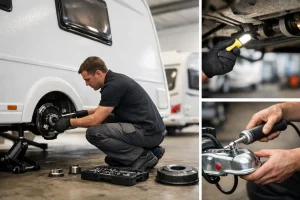
With the trailer safely supported, spin each wheel and listen for grinding, rumbling or roughness. Check for excessive movement by holding the wheel and gently rocking it. Do not ignore a hot hub after a journey either. Heat can indicate a brake binding or failing bearing, and both can worsen quickly under load.
Tyres need more than a quick glance. Check sidewalls for cracks, cuts and bulges, inspect the tread, and confirm pressures when the tyres are cold. Trailer tyres can deteriorate with age even when the tread depth looks good, particularly on trailers stored outdoors or used infrequently. Also check that wheel nuts are secure and tightened to the trailer manufacturer’s specified torque.
Load, suspension and chassis condition
A trailer that is overloaded or loaded badly can feel unstable even when every component is working correctly. Keep heavy items low and close to the axle, secure the load properly and maintain an appropriate noseweight for the vehicle, towbar and trailer. Too little noseweight can encourage snaking, while too much can overload the rear of the towing vehicle.
Inspect leaf springs, axle mountings, suspension components, mudguards and the chassis for cracks, severe rust or loose fixings. Surface corrosion is common, but flaking metal around structural areas, spring hangers or coupling mountings needs professional assessment. Do not paint over corrosion and assume the issue has gone away.
When a trailer fault needs professional repair
Basic checks can identify many faults, but some repairs should not be left to trial and error. Seek professional help if you find damaged chassis wiring, repeated fuse failures, unreliable vehicle-specific electrics, braking faults, a worn hitch, bearing play, significant corrosion or any uncertainty around the breakaway system.
This is especially true where a modern vehicle is involved. Towing electrics can be integrated with parking sensors, rear fog lights, stability systems and bulb monitoring. An incorrect repair may create dashboard warnings, disable functions or leave the trailer lights unreliable. Proper testing equipment and vehicle-specific knowledge make a real difference.
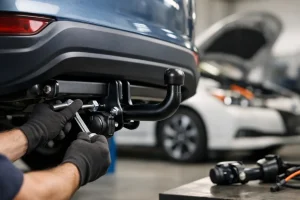
At Doncaster Towbars, trailer faults can be checked from the plug and lighting circuits through to brakes, bearings, coupling condition and general roadworthiness. A workshop inspection is often quicker and safer than replacing parts one by one in the hope that the fault disappears.
Keep faults from returning
A short pre-tow check is one of the best habits a trailer owner can build. Test the lights before every journey, inspect the coupling and safety cable, look at the tyres, and walk around the trailer once it is loaded. After wet journeys, rinse off road salt and dirt where practical, and keep the plug protected when the trailer is parked.
For trailers used only a few times a year, regular servicing is worthwhile. Storage does not prevent wear: brakes can seize, tyres can age, connectors can corrode and bearings can deteriorate without many miles being covered. Addressing a small issue in the workshop is far preferable to discovering it when the trailer is fully loaded and you need to be somewhere.
If something does not look, sound or feel right, trust that warning and have it checked before towing. The best time to deal with a trailer fault is while the trailer is safely on the drive, not when it is following you down the motorway.