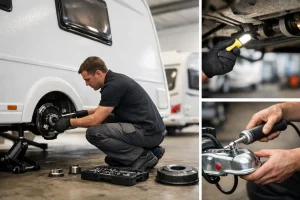
A hybrid may feel like the sensible choice for everyday driving, but that does not automatically mean it is ready to tow a caravan, trailer or bike carrier. Towbar fitting for hybrid cars starts with the exact vehicle, not a one-size-fits-all kit. The approved towing weight, battery layout, exhaust arrangement and vehicle electronics can all affect what can be fitted and what you can safely tow.
For drivers around Doncaster, Rotherham and South Yorkshire, a professional assessment avoids the costly mistake of buying equipment that is unsuitable for the car. Whether you are planning weekends away with a caravan, taking garden waste to the tip or carrying work equipment on a trailer, the right towbar and electrics make the job safer and more straightforward.
Can Hybrid Cars Tow?
Many hybrid cars can tow, but the answer depends entirely on the manufacturer’s approved figures for that particular model and engine. Some full hybrids have a modest towing capacity, while certain plug-in hybrids and hybrid SUVs are capable of pulling heavier trailers or caravans. Others are not approved for towing at all, even where a towbar could physically be mounted.
Never rely on the towing figure for a similar petrol or diesel version of the same car. Hybrid powertrains add weight and can use different cooling systems, rear structures and transmission components. A model’s towing limit may also vary by year, trim level, wheel size or whether it has two-wheel or four-wheel drive.
Before any fitting takes place, check the vehicle handbook and identification plate for the permitted maximum braked trailer weight, unbraked trailer weight, gross vehicle weight and gross train weight. If there is no stated gross train weight, the vehicle is generally not approved to tow. These figures set the limit – fitting a towbar cannot increase it.
Mild, Full and Plug-in Hybrids
A mild hybrid usually has a conventional petrol or diesel engine supported by a small electrical system. In many cases, towing arrangements are similar to the non-hybrid version, but the approved vehicle data must still be checked.
A full hybrid can travel for short periods using electric power alone and uses a larger battery. It may tow well within its rated limits, though drivers should expect the petrol engine to work harder under load and fuel economy to change when towing.
Plug-in hybrids have the largest battery packs and are often considerably heavier. Some make excellent tow cars, particularly larger SUVs, but payload and nose weight need closer attention. The battery may also affect where the towbar mounts, so a vehicle-specific fitting is essential.
Choosing the Right Towbar for a Hybrid Car
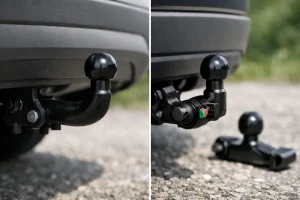
The best towbar is determined by how you intend to use it, as well as the vehicle’s approved ratings. A fixed flange towbar is a practical choice for regular trailer or caravan towing. It is strong, versatile and can accommodate accessories such as a bumper protector, although it remains visible when not in use.
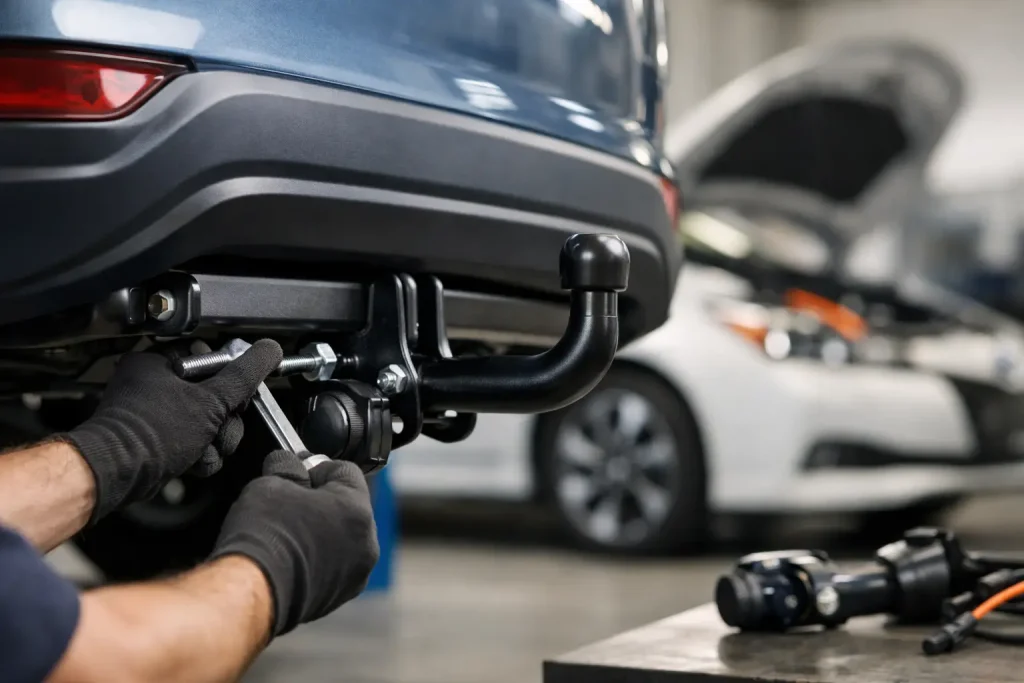
A fixed swan-neck towbar has a neater appearance and is popular for bike carriers and lighter towing duties. On some vehicles, it may be a better match for the rear bumper design. If you want the towbar out of sight when it is not needed, a detachable option removes from the vehicle cleanly. This is especially useful on newer hybrids where owners want to preserve the original look of the car.
The choice is not purely cosmetic. The towbar must have the correct approval for the vehicle and enough capacity for the intended trailer and vertical load. A bike carrier can place substantial weight on the towball, so the towbar’s maximum nose load and the car’s own permitted nose weight both matter.
Do Not Overlook Nose Weight and Payload
Nose weight is the downward force applied by the trailer or carrier onto the towball. It is often the figure that catches people out. A caravan may be below the car’s towing limit but still exceed its permitted nose weight if loaded incorrectly.
Payload matters too. Passengers, luggage, optional equipment and the towbar itself all count towards the maximum permitted vehicle weight. Plug-in hybrids can have less usable payload than expected because of their battery weight. For safe and stable towing, load the trailer evenly, keep heavy items low and close to the axle, and use a nose-weight gauge before setting off.
Why Hybrid Towbar Electrics Need Specialist Attention
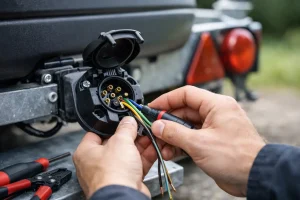
Modern hybrids rely on complex electrical systems and communication networks. Trailer electrics are not simply a case of joining wires to the rear lights. A properly specified vehicle-specific wiring kit is designed to communicate with the car’s systems without interfering with warning lights, battery management or safety functions.
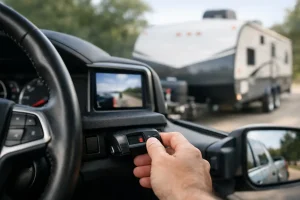
Depending on the vehicle, the electrics may need coding after installation. This allows the car to recognise when a trailer is connected and can activate useful towing functions. These can include trailer stability support, altered parking sensor behaviour, revised rear fog lamp operation and, in some cases, changes to braking or transmission control.
A universal wiring kit may be suitable for certain older vehicles, but it is rarely the first choice for a modern hybrid. Vehicle-specific electrics provide a tidier installation and are more likely to preserve the functions built into the car. The exact approach depends on the make, model and electrical architecture.
If you are towing a caravan, you may need 13-pin electrics rather than a basic lighting socket. A 13-pin setup can supply road lights and additional caravan functions such as interior power, fridge feeds or battery charging, where supported by the car and wiring system. Discuss what you tow before booking so the wiring is matched to the job.
Parking Sensors, Cameras and Rear Safety Systems
A towbar can affect rear parking sensors, particularly if the towball sits within a sensor’s detection area. Without the correct integration, the car may beep continuously when reverse is selected. Professional fitting helps prevent this by using compatible electrics and coding where available.
Reversing cameras, blind-spot monitoring and rear cross-traffic systems can also behave differently with a trailer attached. The vehicle may have a trailer mode, or it may need to be configured through the wiring kit. This is another reason to avoid treating hybrid towbar installation as a basic mechanical job.
What a Professional Hybrid Towbar Fitting Should Include
A proper installation begins by confirming the registration, model variant and manufacturer towing data. The correct towbar and wiring kit can then be selected before any work begins. This prevents fitting unsuitable parts or discovering later that the vehicle is not approved for the intended use.
The fitting itself should follow the towbar manufacturer’s instructions, including correct mounting points, fasteners and torque settings. On many cars, the rear bumper must be removed and may require a discreet cut on the underside. A careful fitter will refit panels neatly and make sure the socket position is accessible without obstructing the trailer coupling.
Once installed, the trailer socket and lighting functions should be tested. Where the vehicle requires coding, that should be completed and checked too. The finished setup needs to work correctly with indicators, brake lights, side lights, reversing lights and rear fog lights before it goes on the road.
At Doncaster Towbars, we can advise on suitable towbar options and vehicle-specific electrics for hybrid cars, based on what you plan to tow or carry. That means a practical solution for a small trailer, caravan, cycle carrier or work equipment, rather than fitting more than you need.
Towing a Hybrid: What Changes on the Road?
A hybrid does not need special towing rules, but it does have its own characteristics. Towing will increase energy use and reduce electric-only range on a plug-in hybrid. The petrol engine may run more often to provide power, maintain battery charge and support heating or air conditioning.
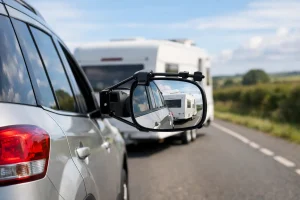
Acceleration will be slower, braking distances can increase and crosswinds will have more effect, particularly with a caravan or tall box trailer. Plan more space around you, use a lower speed where conditions demand it and avoid loading the car or trailer beyond its limits. Before a long trip, check tyre pressures for the loaded condition specified by the vehicle manufacturer.
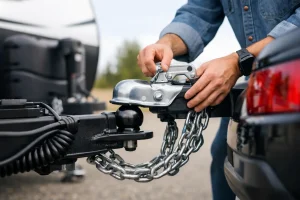
It is also worth checking your motor insurance policy after fitting a towbar and declaring the modification if required. Keep your trailer serviced, inspect tyres and lights regularly, and make sure any breakaway cable or secondary coupling is connected correctly every time.
A hybrid can be a capable, efficient tow car when the vehicle is approved, the equipment is correctly matched and the load is within limits. If you are unsure what your car can tow, or which electrics you need, speak to an experienced fitter before buying parts. A short conversation at the start can give you a safer setup and far more confidence when it is time to hitch up.