
A trailer can look perfectly sound in daylight and still be illegal once the light drops. A missed indicator, an unlit number plate or a poor earth connection can make other road users unable to read your intentions. This guide to legal trailer lighting requirements explains the main UK rules in practical terms, along with the checks that make towing safer before you leave the drive.
Lighting rules can vary with a trailer’s width, age, design and intended use. That is why a small domestic box trailer, a caravan and a wide plant trailer should not simply be treated as the same job with different lamps. The aim is straightforward: your trailer must be visible, its direction changes and braking must be clear, and its lighting must work properly with the towing vehicle.
The essential rear lights on most trailers
For a typical road-going trailer used in the UK, the rear lighting arrangement will usually include two red rear position lamps, two red stop lamps, amber direction indicators, red triangular rear reflectors and a number plate lamp. These are the items most drivers expect to see, and for good reason: they tell approaching traffic where the trailer is, how wide it is, whether it is slowing and which way it is turning.
Rear reflectors are not merely decorative. Trailers generally need two red triangular reflectors at the rear, positioned with the triangles pointing upwards. Circular or rectangular reflectors may be fitted elsewhere where permitted, but they do not replace the required triangular rear reflectors.
The number plate must be lit when the vehicle’s lamps are on. It also needs to display the registration mark of the towing vehicle, not a separate number for the trailer. A dirty lens, faded plate or lamp hidden by a tailgate, cycle rack or load can cause problems even when the wiring itself is sound.
Indicators deserve particular attention. They must flash amber and be clearly visible from the rear. The towing vehicle must also provide a suitable audible or visual warning that the trailer indicators are operating. With modern vehicle-specific electrics, this is often managed through the vehicle’s electrical system. A basic plug-in wiring kit may not communicate with every modern car correctly, which is one reason professional installation is worth considering.
Guide to legal trailer lighting requirements by size
Width affects what extra lighting and marking equipment may be needed. On many trailers more than 1.6 metres wide, front position lamps are required. These show a white light to the front and help oncoming traffic judge the trailer’s width, especially on narrow lanes and unlit roads.
Trailers over 2.1 metres wide normally require front and rear end-outline marker lamps. These are placed as close as practical to the outer edges and make the trailer’s full width easier to see. Wider trailers may also need side marker lamps and additional reflectors along their length, particularly where their dimensions make them less visible from an angle.
Rear fog lamps are another area where the answer depends on the trailer. A rear fog lamp is generally required on trailers manufactured on or after 1 October 1990 that are more than 1.3 metres wide. There are positioning rules as well as fitment rules, so it is not enough to bolt a lamp anywhere on the rear panel. It must be correctly located, wired and bright enough to do its job without being confused with a brake lamp.
Reversing lamps are useful when manoeuvring a caravan or work trailer, but their legal status and required fitment depend on the trailer’s age and category. If fitted, they must operate correctly and show white light only to the rear. They should never be used as a substitute for safe observation when reversing.
Colours, positions and visibility matter
The wrong lamp colour can make an otherwise tidy trailer non-compliant. White light is used to the front, red to the rear, and indicators must show amber. There are limited exceptions for certain functions, but fitting fashionable LED units or replacement lamps without checking their approval and function can create an avoidable issue.
Lamps also need to be mounted at suitable heights, in sensible positions and at matching points across the trailer where a pair is required. They must not be obscured by a load, ramps, mudguards, a cover or accumulated dirt. If you carry timber, machinery or a tall load, check from behind and to each side that every required light and reflector can still be seen.
Use lamps and reflectors that are approved for road use. Good-quality units are more likely to withstand water ingress, vibration and regular coupling than cheap unsealed fittings. LEDs can be an excellent upgrade because they are bright and draw little current, but they must be compatible with the towing vehicle’s electrics. Some vehicles detect a failed bulb by monitoring electrical load, so an LED conversion may need correctly specified components or coding.
Wiring and plugs: where many faults begin
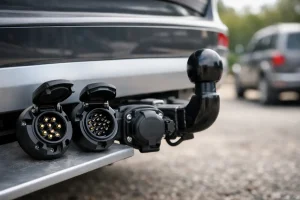
A trailer light is only as reliable as the wiring feeding it. The common 7-pin 12N plug is still widely used for basic road lighting functions. A 13-pin system is common on newer caravans and towing vehicles, providing the core lighting circuits in a more secure connector and allowing additional functions where required.
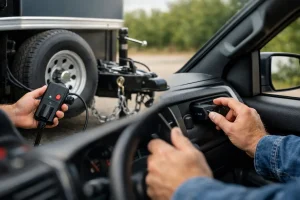
Before every journey, connect the trailer, switch on the vehicle ignition where necessary and test the sidelights, brake lights, indicators, fog lamp and number plate light. Do not rely on a quick glance at one lamp. Ask somebody to operate the controls, use a light board tester, or position the vehicle where reflections show each function clearly.
If lights flicker, work intermittently or behave strangely when the brakes are applied, start with the plug, socket and earth. Corrosion in terminals, damaged cable insulation, loose connections and poor earths are frequent causes. Water can enter a plug that has been dragged across the ground, while a cable routed without protection can be crushed or chafed by the drawbar or trailer body.
Avoid quick repairs that leave bare wire, twisted joints or hanging cable. They may get a lamp working temporarily, but they are vulnerable to vibration and water and can become a roadside failure. Secure the cable so it has enough slack for turns without dragging, and make sure it cannot snag when coupling or uncoupling.
Do not overlook the light board
A light board is often the simplest legal solution where a trailer load covers the vehicle’s rear lamps or number plate. This is common with bicycles, boats, building materials and equipment extending beyond the back of the vehicle. The board needs functioning lights, reflectors and a clearly displayed registration plate, securely mounted where it can be seen.
Treat a light board as part of the trailer setup, not an optional accessory to fetch only after dark. A load can obscure a vehicle’s rear lights in broad daylight, and the legal requirement remains the same. Check that its cable reaches without strain and that the board does not swing, tilt or become hidden by the load during travel.
A practical pre-tow lighting check
A two-minute inspection prevents a great deal of frustration at the roadside. Walk around the outfit with the lamps on, then test each indicator and the brake lights. Confirm that both trailer lamps respond correctly, the plate is clean and illuminated, the reflectors are intact, and no lens is cracked or full of condensation.
Next, check the plug is fully seated and the cable is supported. Look at the trailer from a short distance away, not only close up. This is where a low-mounted lamp hidden by a load or a dim unit on one side becomes obvious. If you are towing a wide trailer, caravan or commercial unit, check its extra marker and fog lamps as well.
For regular users, keep a small set of legal spare bulbs where the lamps use replaceable bulbs, plus fuses and a clean, dry plug cover. With sealed LED lamps, a spare complete unit can be more useful than carrying parts that cannot be changed at the roadside.
When to get the electrics checked
If a new towbar has been fitted, the trailer lights should be tested as part of the completed installation. This matters particularly on newer vehicles with parking sensors, bulb monitoring, stability systems or multiplex wiring. Correct vehicle-specific electrics help protect the vehicle’s systems and ensure the trailer functions are recognised as intended.
Persistent blown fuses, cross-functioning lights, no trailer indicator warning or a fog lamp that will not operate are signs to stop guessing and have the wiring inspected. At Doncaster Towbars, trailer and vehicle electrics can be checked alongside towbar fitting, repairs and servicing, so faults can be traced properly rather than masked with a temporary fix.
A working trailer lighting system is one of the clearest signals you can give on the road. Make the check part of every coupling routine, keep the fittings clean and protected, and deal with small faults before the next early start, school run or weekend away turns into an unnecessary delay.