A tight supermarket bay, a low bollard behind a van or the awkward final few inches when lining up a trailer can turn an ordinary reverse into a guessing game. When comparing rear sensors vs reversing camera systems, the best choice is not always the newest-looking option. It depends on your vehicle, how you use it and what you need to see or avoid.
For many drivers, rear parking sensors provide quick, dependable warning without taking attention away from the mirrors. A reversing camera gives a direct view behind the vehicle, which can make a major difference around low obstacles, trailer couplings and poorly marked spaces. Both can be professionally fitted to cars, SUVs and commercial vans, and both are useful upgrades. The right answer comes down to the situations you face most often.
Rear sensors vs reversing camera: the key difference
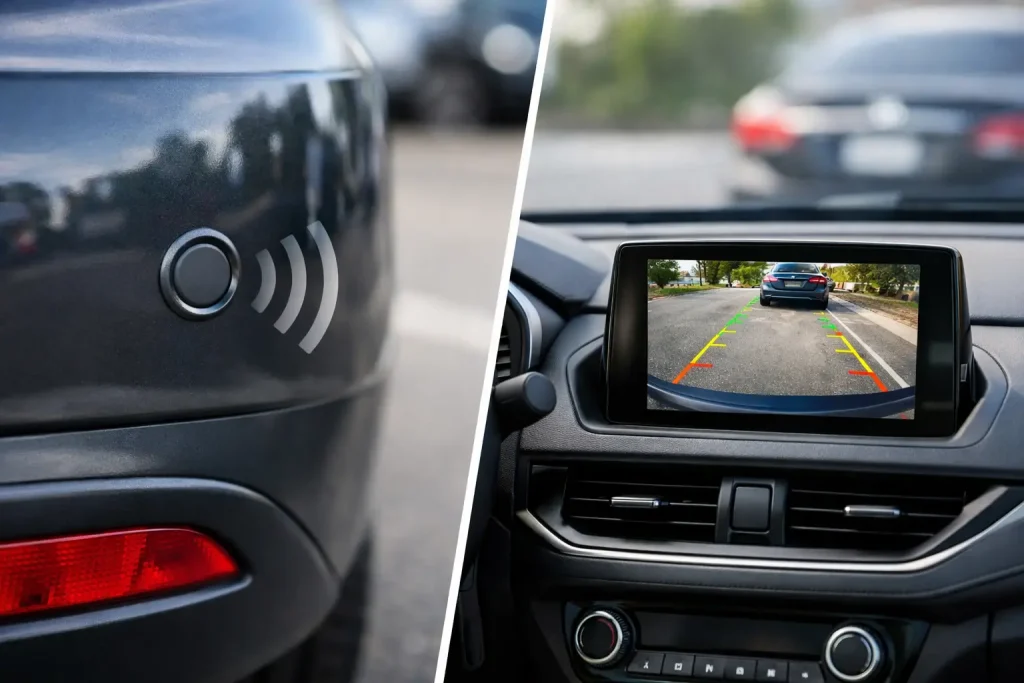
Rear sensors use ultrasonic detection. Small sensors mounted across the rear bumper send out sound waves and measure how quickly they return from an object. As you get closer, the audible beeps become faster. Some systems also show a simple distance display on a separate screen or mirror display.
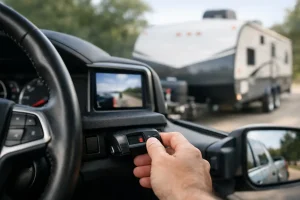
A reversing camera shows a live image of the space behind the vehicle when reverse gear is selected. Depending on the setup, the picture may appear on the existing infotainment screen, a replacement display, a rear-view mirror monitor or a dedicated screen. Most cameras include guide lines to help judge the vehicle’s path.
In straightforward terms, sensors tell you that something is close. A camera helps show what that something is. Neither completely replaces checking mirrors and looking around before reversing, but each adds a useful layer of awareness where a driver’s view is limited.
Why rear parking sensors still make sense
Parking sensors are a practical choice for drivers who want a clear warning system with minimal distraction. Once fitted, they work automatically when reverse is selected. There is no image to interpret and no screen position to consider. The increasing beep rate gives a prompt reminder to slow down and assess the space behind you.
They are particularly useful in everyday parking where the concern is avoiding a wall, another vehicle or a post. They also work in darkness, because they do not rely on a visible image. For a vehicle with limited rear visibility, such as a panel van with solid rear doors, sensors can offer valuable reassurance.
The fitting can be neat and discreet. Colour-matched sensors can blend into many bumpers, while flush-fitting options give a more integrated finish where suitable. A good installation matters here: sensor position, angle and spacing affect how reliably the system detects objects across the rear of the vehicle.
There are limits. Sensors may not reliably pick up very slim objects, unusual shapes or items positioned outside their detection range. They cannot tell you whether the object is a kerb, a bike, a child’s toy or a high obstacle that sits beyond the sensor zone. They are an alert system, not a picture of the area.
Sensors and towbar use
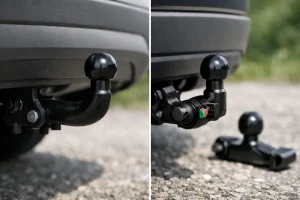
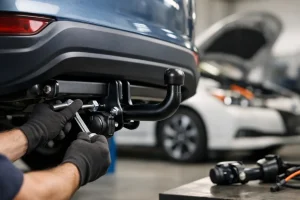
A towbar adds an extra consideration. Depending on the vehicle and the sensor system, the hitch may be detected as a permanent obstruction, causing unwanted warning tones. This is not a reason to avoid sensors, but it is a reason to choose a fitting approach that accounts for the towbar and vehicle electrics.
Some vehicles can be configured to recognise towing equipment, while aftermarket systems may need careful positioning or a suitable override arrangement. If you tow regularly, explain this before fitting. A workshop that handles both towbars and parking aids can assess the bumper layout, hitch position and intended use together rather than treating them as unrelated jobs.
Where a reversing camera earns its place
A reversing camera is strongest when you need information rather than just an alert. It can show a low wall, a kerb, a child’s scooter or the exact position of a trailer coupling. For drivers who reverse into narrow drives, work sites or storage areas, that added visibility can be genuinely useful.
It is also a sensible option for vans. A camera mounted high on the rear door or above the number plate can give a far better view than mirrors alone, especially on a loaded vehicle. Wide-angle lenses show a broad area, helping the driver spot movement near the rear corners as well as directly behind.
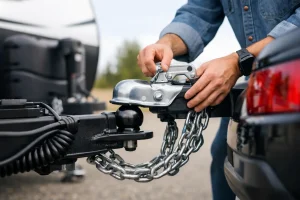
For towing, a camera can make coupling up less frustrating. Seeing the towball and trailer hitch can help the driver line up more accurately, reducing the back-and-forth adjustments that are common when working alone. The camera does not remove the need to get out and check the connection, safety cable and electrics, but it can make the approach more controlled.
A camera has its own compromises. Its lens can collect road grime, rain and condensation, so the image may need an occasional wipe. Bright sunlight, deep shadow and heavy rain can also affect what you see. Wide-angle views are helpful, but can distort distance, making objects appear further away than they really are. Guide lines should be treated as an aid, not an exact measurement.
Is one system enough?
For some drivers, absolutely. If your priority is avoiding bumper knocks in normal car parks, rear sensors are often all that is needed. They are quick to understand, effective in low light and usually the more straightforward option.
If you regularly reverse a van, need to line up with a trailer, have poor rear visibility or want to see what is behind you before committing to a manoeuvre, a camera is often the better single upgrade. It provides context that beeps cannot.
The most useful answer for many vehicles is both. Sensors provide the immediate warning as you approach an obstacle, while the camera lets you identify it and judge its position. This combination is particularly worthwhile on larger SUVs, vans and vehicles used for towing, where the area behind the vehicle is harder to monitor from the driving seat.
There is no need to pay for features that do not suit the way you drive. A small hatchback used mainly for local errands may be well served by sensors. A trade van visiting unfamiliar properties every day may benefit more from a camera or a combined system. Think about the manoeuvre that causes you the most difficulty, rather than choosing solely on price or appearance.
Choosing a system for your vehicle
Before booking a fitting, consider where the display or alerts will be used. A camera can be integrated with compatible factory equipment on some vehicles, but not every original screen accepts an aftermarket camera input. A separate monitor may be the most sensible route in other cases. The system should switch on reliably with reverse gear and be positioned so it does not obstruct essential controls or the driver’s view.
For sensors, bumper construction matters. Curved bumpers, metal reinforcement behind the plastic and existing parking equipment can all influence placement. A professional installer will check that the system is suitable for the vehicle before drilling, route wiring securely and test the detection zones after fitting.
Commercial vehicles need a little extra thought. Rear doors, ladder racks, steps, towballs and drop-down tail lifts can alter what a camera sees and what sensors detect. The goal is not simply to fit equipment, but to fit equipment that remains useful in day-to-day work.
Professional fitting is worth considering
Parking aids rely on more than the parts in the box. Poor camera placement can leave a blind spot. Incorrectly angled sensors can give nuisance warnings or miss objects. Untidy wiring can create future faults, while unsuitable connections can interfere with vehicle systems.
A properly fitted system should look purposeful, operate when expected and be explained clearly before you leave. At Doncaster Towbars, parking sensor and reversing camera requirements can be considered alongside towbars, trailer electrics and other vehicle upgrades, helping ensure the finished setup matches how the vehicle is actually used.
If you are unsure which option will help most, bring the decision back to the manoeuvres you make every week. The right parking aid is the one that gives you a clearer, calmer view of the space behind you before a minor reverse becomes an expensive repair.